How to Claim GST Refund on Deemed Exports
Deemed exports play an important role in India’s domestic supply chain by supporting eligible supplies of goods under specified government schemes. Although these goods do not physically leave India, certain notified supplies qualify as deemed exports under Section 147 of the CGST Act, 2017. Businesses involved in such transactions must understand the applicable GST refund provisions to manage their tax obligations effectively.
Choosing professional assistance from the Best GST refund services in India can help businesses understand eligibility requirements, prepare supporting documents, and follow the prescribed refund procedures.
What Are Deemed Exports Under GST?
Deemed exports refer to specified supplies of goods manufactured in India that are treated as deemed exports under applicable GST notifications. Unlike zero-rated exports, deemed exports are generally subject to GST, and eligible tax refunds may be claimed according to the prescribed rules.
Businesses should verify whether their transactions qualify under the relevant notifications before initiating a refund claim. Correct classification is essential to avoid procedural errors and unnecessary delays.
Who Can Claim a GST Refund on Deemed Exports?
Under the applicable GST provisions, a refund claim for deemed export supplies may be filed by the eligible supplier or recipient, subject to the prescribed conditions and documentation requirements. Only one party can claim the refund for the same tax amount, and the other party must provide the required declaration or undertaking, wherever applicable.
Businesses should carefully review the relevant invoices, tax payments, and eligibility conditions before filing their applications.
Steps to Claim a GST Refund on Deemed Exports
1. Verify Eligibility: Confirm that the goods and transactions meet the applicable deemed export conditions and notification requirements.
2. Prepare Supporting Documents: Collect relevant tax invoices, proof of tax payment, purchase records, declarations, undertakings, and other documents required for the particular claim.
3. File the Refund Application: Submit the application electronically in Form GST RFD-01 under the appropriate refund category, following the applicable GST rules and portal requirements.
4. Review the Application: Check invoice details, tax amounts, supporting statements, and declarations for accuracy. Respond promptly if the department requests additional information or clarification.
5. Track the Refund Status: Monitor the application and address any deficiencies or queries raised by the relevant GST authority.
Common Challenges in GST Refund Claims
Businesses may face refund delays due to incorrect invoices, incomplete documentation, discrepancies in tax records, incorrect refund categories, or missing declarations. Inadequate understanding of GST provisions can also lead to avoidable compliance issues.
Maintaining organised records, reviewing eligibility before filing, and checking the latest applicable rules can help businesses reduce errors and manage refund applications more efficiently.
How JNP Consulting Can Help
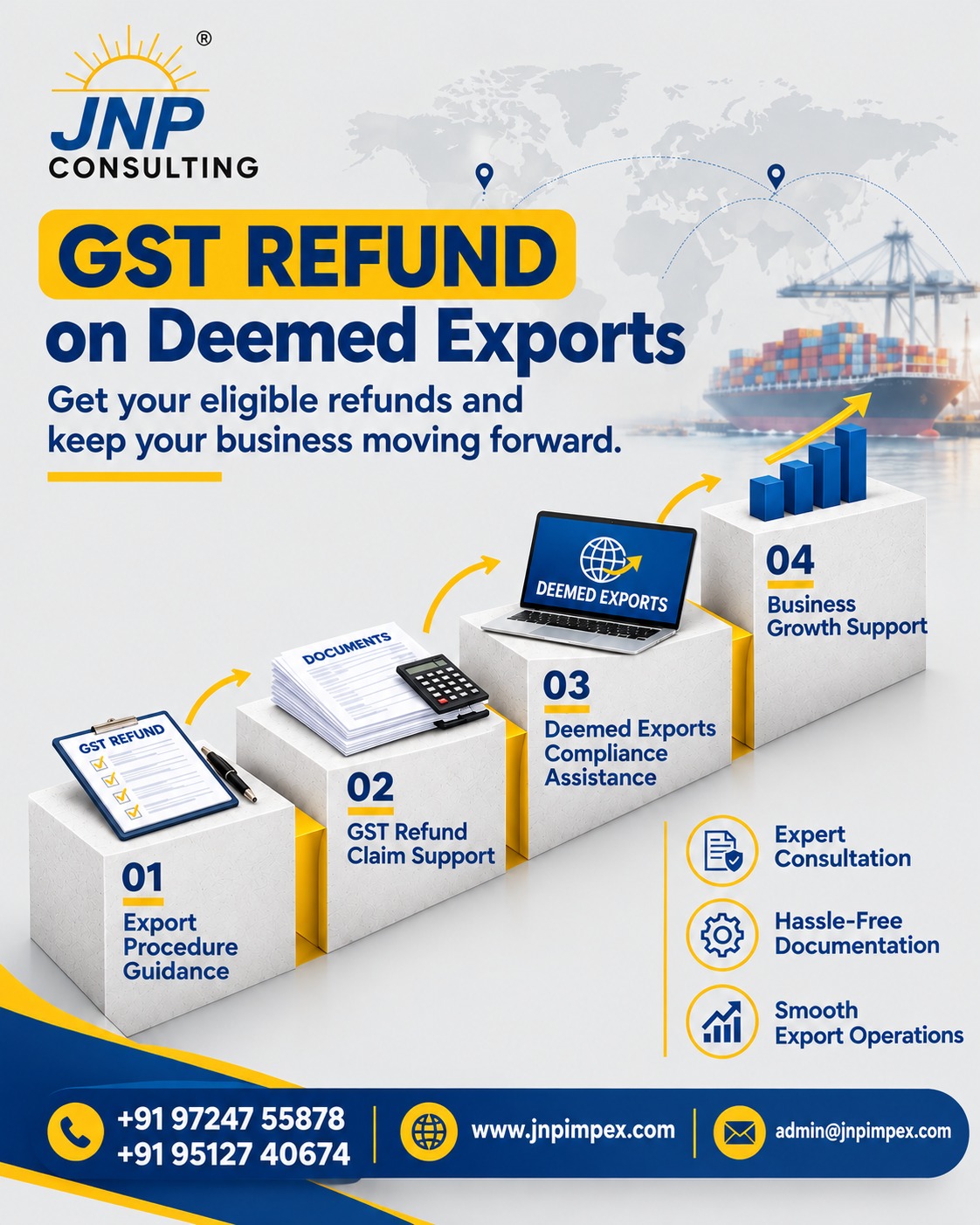
JNP Consulting supports businesses with GST refund documentation, eligibility reviews, application preparation, and compliance guidance. Our approach focuses on helping businesses understand the applicable requirements and organise the necessary records for their refund claims.
For companies seeking the Best GST refund services in India, professional guidance can make complex documentation and procedural requirements easier to manage. Every refund remains subject to applicable laws, eligibility conditions, and approval by the relevant authority.
Conclusion
Claiming a GST refund on deemed exports requires accurate documentation, proper eligibility assessment, and compliance with prescribed procedures. Businesses that review their transactions carefully and maintain complete records can reduce avoidable errors during the process.
JNP Consulting helps businesses navigate GST refund requirements with structured documentation and compliance support.